So far, GLAM has supported strategies across trading, lending, staking, swaps, and liquidity. The next expansion is now available in staging.
This staging release includes integrations with Loopscale, Phoenix, Orca, Exponent, Project 0 / Marginfi, and Jupiter Lend.
These GLAM integration adapters have not yet completed audit review. They are available for validation, feedback, and strategy development, but should not be treated as production-ready.
Why This Matters
Institutional portfolios run on more than yield. They take and hedge directional risk, diversify credit, manage duration, and deploy capital-efficient liquidity.
DeFi markets are becoming more specialized. Credit venues, perpetual exchanges, AMMs, rate markets, and margin systems each introduce distinct mechanics and risks. Managers need access without managing each venue as an isolated workflow.
GLAM vaults provide the coordination layer. A manager can define approved protocols, assign execution authority, restrict eligible assets, and keep strategy activity inside a risk perimeter.
What Is Now in Staging
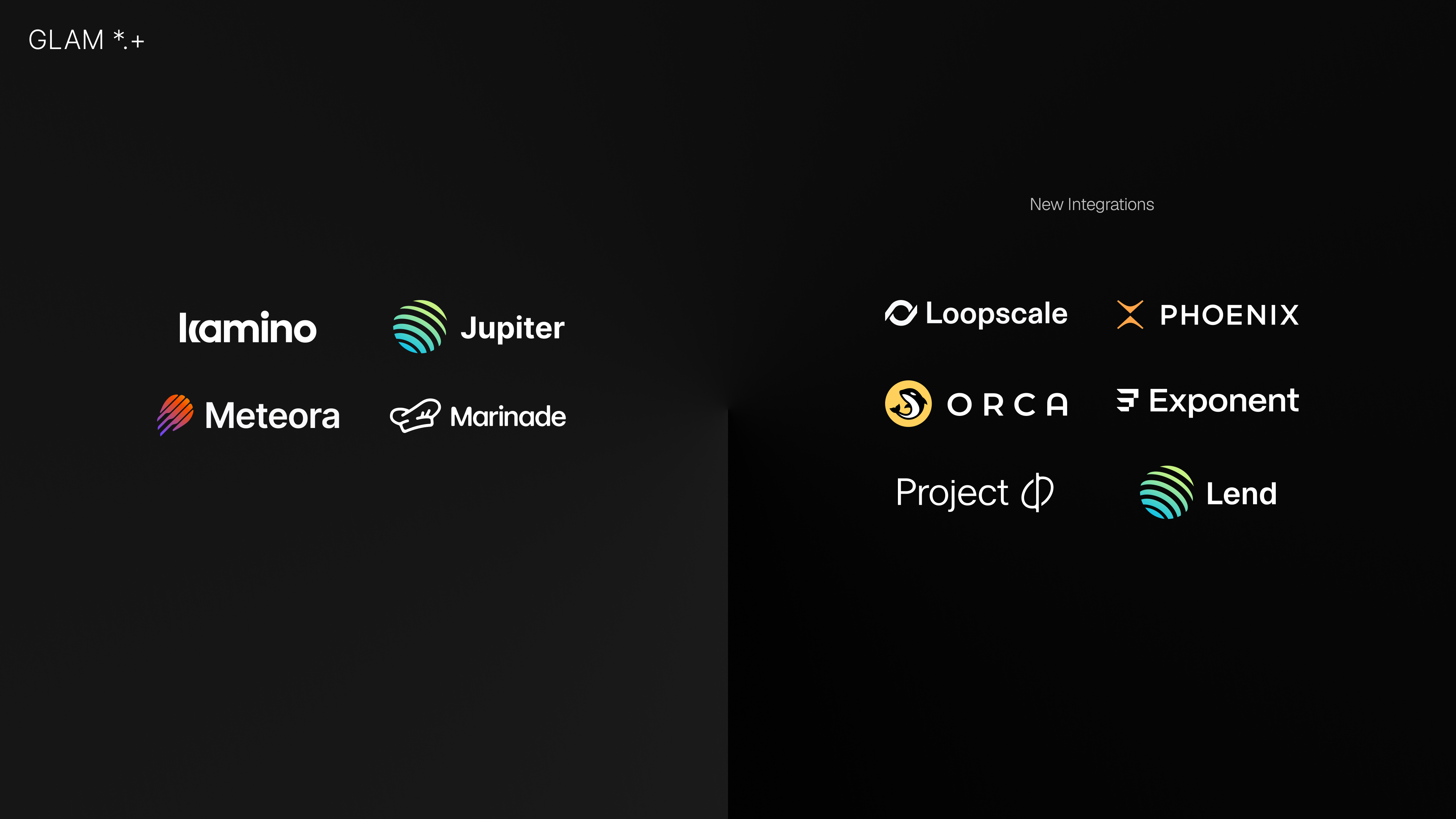
With Loopscale, GLAM vaults can access fixed-rate, fixed-duration credit through an order book lending model, giving vaults a more explicit payoff curve.
Phoenix brings perpetual futures execution into the vault environment. Managers can explore hedging, directional exposure, and basis trades with governance around collateral movement, position sizing, and delegated trading permissions.
Orca extends the liquidity toolkit through concentrated liquidity and swap depth. Vault managers can express LP positions as defined range exposures, with pool selection and exit logic governed by policy.
Exponent introduces rate markets and yield instruments. Yield becomes a tradable asset, opening workflows around fixed-rate exposure, maturity selection, variable yield views, and interest-rate positioning.
Project 0 / Marginfi broadens the credit and margin surface across portfolio credit, collateral flows, borrow limits, liquidation considerations, and multi-venue exposure.
Jupiter Lend brings Earn and Borrow flows into staging, supporting lending allocation, treasury yield, and diversification across protocols with different risk parameters and liquidation mechanics.
Together, these primitives expand what managers can build inside a vault.
From Access to Composition
Three patterns that previously required either a centralized desk or a stack of bespoke integrations:
Hedged carry. A vault loops yield-bearing collateral on Loopscale and opens an offsetting Phoenix short, leaving the yield spread as the net position rather than the underlying asset.
Fixed income mandate. A vault deposits USDC into Jupiter Lend and Kamino across approved markets, then locks part of the variable yield through Exponent for a defined maturity.
Delta-hedged liquidity provision. A vault provides concentrated liquidity through Orca, hedges inventory drift with Phoenix perps, and routes idle collateral into Jupiter Lend between rebalance windows.
The onchain industry has spent years building protocols. What has been missing is the layer that turns protocols into strategies, mandates, and reportable positions.
That is what GLAM is building. Each integration in this wave extends what a mandate can express while preserving the same control plane, policy enforcement, and NAV across every position the vault holds.
Get Started
If you are a manager, allocator, protocol team, or integration partner interested in these staging integrations, reach out to GLAM. We are inviting feedback on strategy workflows, operational requirements, risk controls, and production readiness before audit and release.