Most tokenized vaults start with a narrow assumption: the strategy lives where the token lives. That works for a single-chain swap-and-stake product. It falls apart the moment a real portfolio shows up.
A manager wants Solana-native subscriptions and redemptions, Solana-speed settlement, and Solana DeFi execution. They also want to hold collateral at a custodian, take yield on another chain, run a hedge at an exchange, and carry a private credit position that only exists as a quarterly NAV report.
The question is not whether every asset can physically live on Solana. The question is whether every asset can be brought under a Solana vault, tokenized, controlled, accounted for, and made available to Solana-native capital.
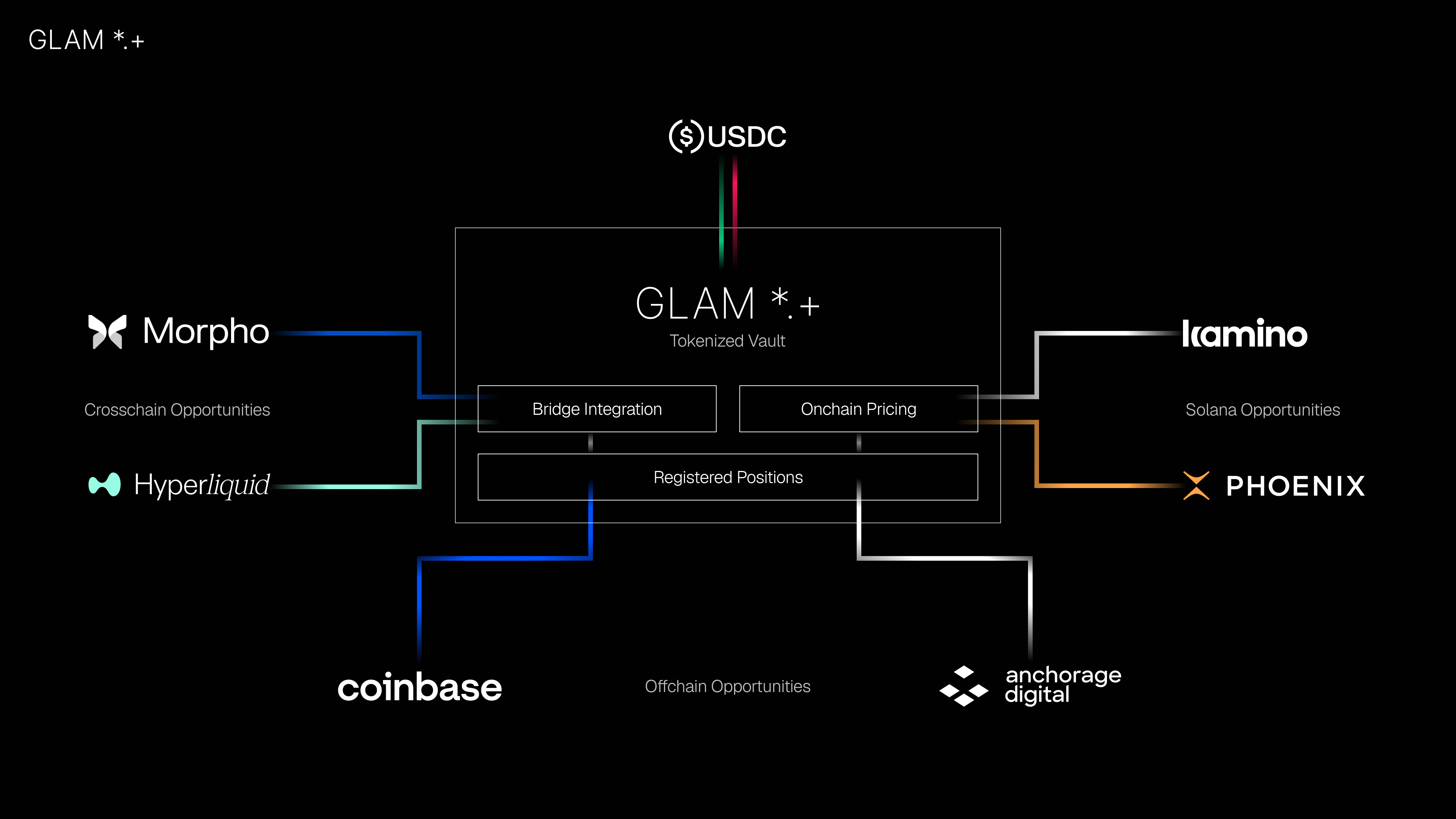
That is what GLAM is built for. The vault uses Solana as the operating layer for a strategy that doesn't have to be Solana-only. Assets get bridged in, deployed into DeFi, routed back out through policy-bound paths, or represented as registered positions when they can't move onchain at all.
Solana As The Execution Layer
Solana is where the vault actually runs. Holding assets, enforcing delegate permissions, routing approved actions through integrations, and pricing the vault for subscriptions, redemptions, and NAV. The manager does not get a blank check over vault assets, every action passes through the onchain policy engine.
That also matters for hybrid strategies. Once assets arrive on Solana, they can move into swaps, lending, liquidity, staking, and whatever else comes online. The vault grants one delegate permission to trade, another to update NAV, another to bridge, another to submit registered observations.
The result is not a wallet with a share token glued to it, but a controlled execution environment.
Bringing Assets To Solana
GLAM supports bridge-aware vault operations through CCTP and LayerZero OFT.
CCTP gives vaults a controlled route for native USDC. A vault can whitelist a specific destination domain and recipient, for example a corresponding vault address on Base. A delegate still needs CCTP transfer permission, and the destination must match policy. If a manager tries to send USDC anywhere else, the transaction fails.
LayerZero OFT extends the same logic to omnichain fungible tokens. Routes are specified explicitly: source mint, destination chain, recipient, provider program, management mode, min/max size. Bridging becomes a vault policy, not an offchain instruction.
In-Flight Assets
Bridges create an accounting problem. For a period of time, assets may have left Solana without being reconciled on the destination side. Most vault architectures pretend this state doesn't exist, we don't.
GLAM's managed bridge flow makes the in-flight state explicit. A managed transfer is committed, then validated, and finally settled. Only validated transfers can be priced. Once settled, the in-flight record is removed.
Registered Assets
Not every asset can be bridged. Some live at brokers, exchanges, custodians, private credit platforms, RWA issuers, or other chains where the vault can't directly read every state transition.
GLAM handles those through the Registered Position Integration (RPI). RPI lets a vault account for registered value in NAV. Positions can be value-based or tokenized, denominated in USD or a supported mint, representing assets or liabilities.
The flow is submit and validate. A permitted submitter reports an observation and validator promotes it into the priced protocol used for AUM. Observations must be fresh, and must match the configured denomination. NAV requires that every vault token be priced and every tracked registered position be included in the priced set. If anything is missing or stale, validation fails.
A Practical Example
Start with a vault on Base.
The Base-side vault bridges USDC into a GLAM vault on Solana using CCTP. On Solana, the GLAM vault deploys into approved DeFi strategies. Investors still hold exposure through a tokenized vault structure.
The return path is constrained. The GLAM vault can only bridge USDC back to the corresponding Base vault address. If a delegate tries to bridge to an arbitrary recipient, policy rejects it.
If part of the strategy remains on Base, that sleeve is represented through RPI. A reporting role submits the value and a validation role approves it. If the report is stale, unauthorized, or incomplete, it cannot enter the NAV.
That is the hybrid model: Bring assets to Solana when they can be used in DeFi, represent them externally when they cannot, and account for the whole strategy onchain.
Don't Trust, Verify
Hybrid vaults expand trust assumptions. A vault may rely on bridges, oracles, custodians, exchanges, brokers, reporting services, or validator roles. GLAM gives managers and allocators a framework to reduce discretion.
Services like Accountable, Wormhole Queries, and Chainlink CRE matter because they reduce how much trust sits with the manager. Accountable can help prove reserves or account health, Wormhole Queries can verify cross-chain state, and Chainlink CRE can coordinate verifiable workflows across APIs, offchain systems, and smart contracts.
We are actively exploring how to integrate these and similar primitives. Every one we add is one less trust assumption that has to sit with the manager.
Why The Hub Has To Be Solana
Tokenized vaults are not just about issuing shares. They should be built to hold capital, use DeFi, bridge across chains, account for registered assets, and publish NAV with enforceable controls.
GLAM makes Solana the hub because the control layer needs to be fast, cheap, and composable enough to price a vault, enforce policy, and route capital in real-time.
Bridging & Registered Positions are live in our staging environment. Reach out for early access.